


ISSN: 0323-9004-Book Edition
ISSN: 2367-9301-Electronic Edition
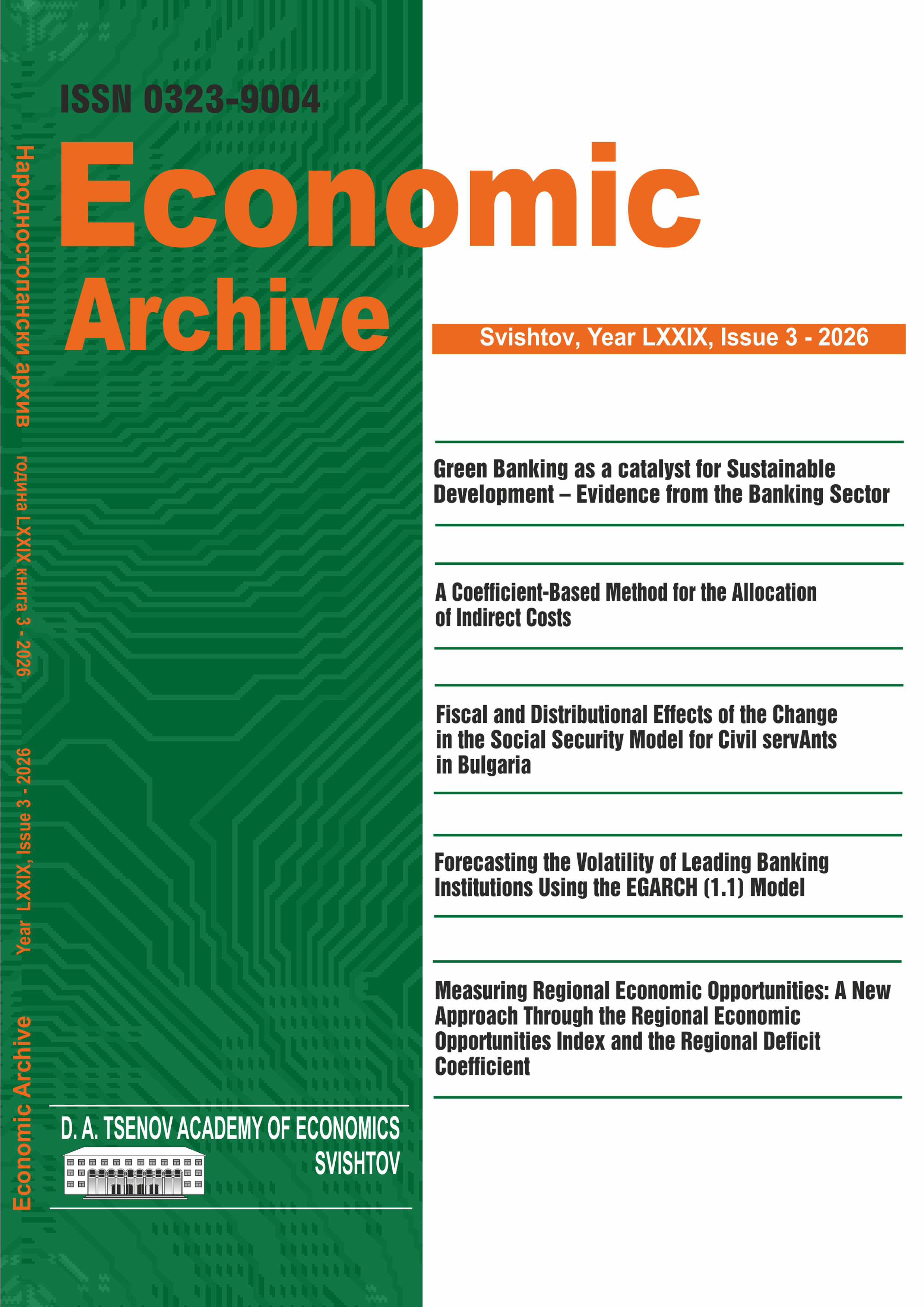
Mihail Chipriyanov, Mario Stephan Hopfner Green Banking as a catalyst for Sustainable Development – Evidence from the Banking Sector / 3 Rosen Iliyanov Kolev A Coefficient-Based Method for the Allocation of Indirect Costs / 23 Teodor Nenov, Ivaylo Kanev Fiscal and Distributional Effects of the Change in the Social Security Model for Civil servAnts in Bulgaria / 34 Petar Georgiev Dzhelepov Forecasting the Volatility of Leading Banking Institutions Using the EGARCH (1.1) Model / 47 Stefka Chilova Measuring Regional Economic Opportunities: A New Approach Through the Regional Economic Opportunities Index and the Regional Deficit Coefficient / 72

This article examines the role of green banking as a catalyst for sustainable development, with particular attention to the global banking sector. A mixed-methods, desk-based research design is employed. The quantitative component synthesizes secondary evidence ...

The allocation of indirect costs is one of the fundamental issues that has long been, and continues to be, important for manufacturing enterprises. For management accounting and accounting professionals, one of the most challenging issues is selecting an appropriate ...

This study analyses the fiscal and distributional effects of the phased introduction of personal social insurance contributions for civil servants under the Civil Servants Act (CSA) and for employees under the Judiciary Act (JA). The main argument is that the ...

This study focuses on the analysis and forecasting of stock price volatility among leading banking institutions using the EGARCH (1,1) model. In a dynamic and often volatile financial environment, the accurate modeling of market risk is of critical importance to both ...

This study proposes a new approach for measuring regional economic disparities using the Regional Deficit Coefficient (RDC), a measure based on the Regional Economic Opportunity Index (REOI) developed by the author and the National Economic Opportunity Index (NEOI). ...

"Economic Archive" is the first academic economic journal in Bulgaria. From 1st of January 2017 the English language title of the journal is changed from “Narodnostopanski archiv” (transliterated from Bulgarian) to “Economic Archive”. The decision to be issued under the name "Narodostopanski archiv" (changed to "Narodnostopanski archiv", now “Economic Archive”) was taken at a meeting of the Academic Council of October 1st 1945 (recorded in Protocol № 100). A quarterly period of issue was

Requirements for submission of papers for "Economic Archive" journal.
1. Number of pages: minimum - 12 pages;
maximum - 20 pages.
2. Submission of papers:
a printout (paper) and an electronic version(CD);
abstracts of half a page;
Card of the author (s) with E-mail and GSM.
3. Technical specifications:
Word 7.0 (minimum);
page size A4, 29-31 lines and 60-65 characters per line;
font -
„Economic Archive“ journal is a scientific economic periodical of D. A.Tsenov Academy of Economics- Svishtov. In Book 1 of 1946, in the editorial of Prof. Todor Vladigerov, the foundations of the editorial policy of the journal were laid: "... to discuss and propose solutions to current problems of the economy ...".
The journal is published in four books a year.
In 2009, the Journal launched its international issue in English, in which the translations of the leading publishing articles from the previous year were presented. Since 2013 the journal has been published as a bilingual edition (in Bulgarian and English). Since 2014 the journal has been freely accessible and available on the Internet (http://www2.uni-svishtov.bg/nsarhiv/).







The Currency Board in Bulgaria: Theoretical Reflections and Empirical Results
Via this article the authors would like to discuss the idea of the inter-section point of theoretical reflections and reported empirical results referring to the currency board in Bulgaria. To achieve the goal defined the article is structured in the following separate sections: first, clarification of the concept of a currency board in light of leading theoretical research; second, critical analysis and evaluation of the characteristics of the currency board in Bulgaria; third, justification ...

FUTURE EURO AREA MEMBERSHIP OF BULGARIA IN TERMS OF THE BUSINESS CYCLE
In the present paper, vector autoregression (VAR) is used to assess the extent to which Bulgaria’s economic cycle is synchronized with the one of the euro area (EA). The main fiscal and monetary factors affecting the coordination of the business cycles of Bulgaria and the EA are identified. Recommendations for macroeconomic policies are formulated to support the synchronization of Bulgaria’s economic cycle with the one of the EA and to prepare our country for the adoption of the euro. ...

A New Yuan or a New Monetary System
The research area of the present study is the Chinese yuan (renminbi). The research subject is the evolution of the Chinese yuan from a national to a global reserve currency. The paper tests the proposition that the rise of the Chinese currency is a sign of deep and qualitative changes in the international monetary system. The aim of the study is to analyse and track the evolution in the current situation in the international monetary system, in order to highlight the factors and the reasons ...